
Speed up clearances by extracting shipping doc data automatically
Trade compliance teams handle 5-10 documents per shipment from a different carrier, broker, and origin country every time. Bills of lading from Maersk look nothing like Hapag-Lloyd. Customs declarations vary across 15+ countries. Certificates of origin use stamps that move between issuers. The data is structured, but the formats are not — so every shipment becomes a manual review. DocumentIQ extracts shipper, consignee, HS codes, declared values, container counts, and origin attestations from any of these formats in a single pipeline, with carrier- and country-specific annotations that handle layout differences automatically.
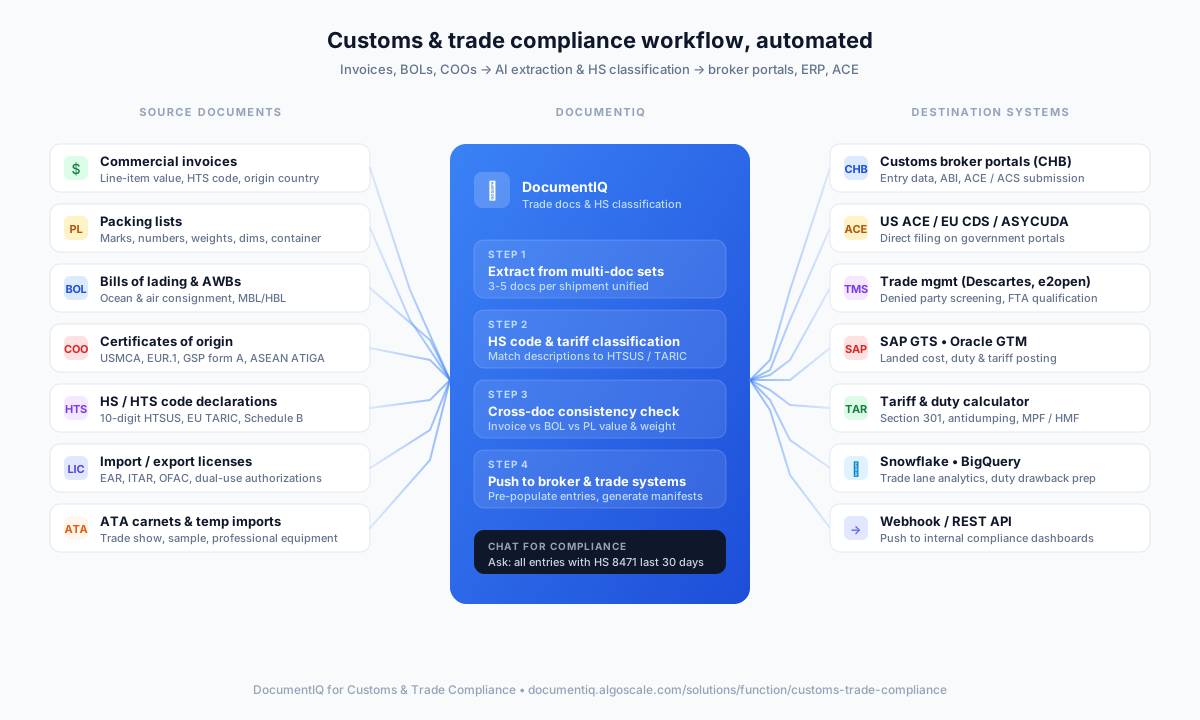
How customs & trade compliance runs on DocumentIQ
The end-to-end document path for customs & trade compliance — source files from your existing systems, AI extraction in DocumentIQ, structured data pushed to the platforms your team already uses.
The Challenges
Carrier-specific BOL formats
Every carrier has its own bill of lading layout. The same fields — shipper, consignee, weight, piece count — appear in different positions on every template, breaking generic extraction tools.
Customs paperwork volume
Each clearance requires data from 3-5 documents: commercial invoices with tariff line items, packing lists, certificates of origin. Brokers spend more time on data extraction than on actual compliance work.
Duty exposure surfaces too late
Declared values, HS codes, and origin attestations determine duty liability. Without structured visibility before the shipment lands, compliance teams discover misclassification when the duty bill arrives.
Origin paperwork inconsistency
Certificates of origin from different chambers and authorities use different layouts and stamp positions. Manual review is the only way to verify them — slow, error-prone, and a customs audit risk if wrong.
How DocumentIQ Solves This
Carrier annotations
Train DocumentIQ once per major carrier — Maersk, MSC, Hapag-Lloyd, ONE — and it generalizes across new BOL revisions. New carriers onboard in minutes with 5-10 annotated examples.
Multi-document workflows
Group commercial invoice + packing list + COO + declaration into a single shipment record. Cross-validate that the declared value and HS codes match across all four documents — flag mismatches before they hit customs.
Country-specific declaration extraction
Built-in field templates for major customs declaration formats — US 7501, EU SAD, UK CDS — with annotations for jurisdiction-specific fields like incoterm, country of origin, and duty calculations.
Real-time exception queue
Confidence scores per field surface ambiguous extractions for human review. A trade compliance specialist resolves 20 exceptions per hour instead of typing in 200 shipments per hour.
Used in these industries
Manufacturing
DocumentIQ helps manufacturing teams digitize invoices, spec sheets, and quality certificates at scale — eliminating transcription errors and freeing engineers from data entry.
Learn moreLogistics
DocumentIQ automates extraction from bills of lading, customs declarations, and receiving docs — eliminating data entry backlogs and cutting clearance times.
Learn moreDocument types we extract for this function
Extract shipper, consignee, origin, destination, and freight details from bills of lading for logistics automation.
Packing List ExtractionExtract package counts, weights, dimensions, and contents descriptions from packing lists for warehouse operations.
Certificate of Origin ExtractionExtract exporter details, HS codes, and certifying authority from certificates of origin for trade compliance.
Customs Declaration ExtractionExtract HS codes, declared values, incoterms, and duty rates from customs declarations for trade compliance automation.
Related services from Algoscale
End-to-end AI strategy for trade compliance
Connect extraction to your TMS, customs broker, or freight forwarder system
Apply LLMs to logistics document automation
Build a unified shipment record from heterogeneous documents